• Home
  • Blog
  • Who We Are
  • Contact
  • Home
  • Blog
  • Who We Are
  • Contact

Steamboat Rock Dam

a river restoration project

Freshwater Mussels

10/18/2019

 
Prepared by – Jennifer Kurth, Aquatic Biologist – Watershed Monitoring Coordinator, Iowa DNR
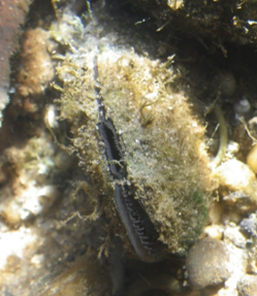
PictureMussel covered in algae
Freshwater mussels may not be as well-known as the fish species we have in Iowa, but they are an important part of a healthy river, stream, or lake. Mussels are filter-feeders. This means they eat by filtering algae, bacteria, and other organic material out of the water, like a living water-filtration system. What they can’t eat gets bound up in mucus and deposited on the bottom where it can be eaten by other animals. Depending on size, an adult mussel can filter 12 to 36 gallons of water per day! However, this filtering activity makes them vulnerable.  Mussels are sensitive to a wide array of pollutants, and are among the most sensitive groups of organisms tested for ammonia pollution. Therefore, mussels are good indicators of water quality and the health of the waterbodies in which they live. 

​In addition to helping to clean the water, mussel beds have been shown to stabilize the river bottom against the scouring effects of flowing water. Mussels also provide habitat for other aquatic organisms. It is not unusual to find mussels with algae growing on their shells (Figure 1) or insect larvae attached to the shells. Snails will actually graze on the algae growing on mussels, like cows in a pasture. Additionally, empty shells are often used by fish and crayfish as egg laying sites or hiding places

Mussels are also an important source of food for wildlife and fish species, such as muskrats, raccoons, otters, and the freshwater drum and lake sturgeon. Both muskrats and raccoons leave discarded piles of shells (middens) on the shore, which can provide information about the mussel species found in the area. While freshwater mussels were used as food by Native Americans in the past, eating them is not recommended now, both because of their precarious status in Iowa, and because, as filter feeders they accumulate any pollutants that may be present in our waters.
Recent surveys have found 12 species of mussel living in the part of the Iowa River around the Steamboat Rock Dam, including 2 species listed as threatened by the state of Iowa, indicating that there is good habitat and that the river is a healthy place for mussels.
Picture
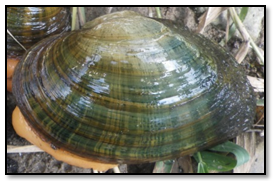
Elktoe (Alasmidonta marginata)
Picture
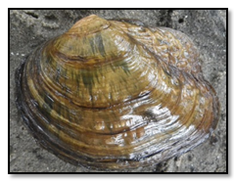
Monkeyface (Theliderma metanevra)

​Species found near Steamboat Rock Dam:
  • mucket (Actinonaias ligamentina)
  • elktoe (Alasmidonta marginata)
  • pimpleback (Amphinaias pustulosa)
  • Wabash pigtoe (Fusconaia flava)
  • fatmucket (Lampsilis siliquoidea)
  • plain pocketbook (Lampsilis cardium)
  • white heelsplitter (Lasmigona complanata)
  • creek heelsplitter (Lasmigona compressa)—threatened
  • flutedshell (Lasmigona costata)
  • giant floater (Pyganodon grandis)
  • creeper (Strophitus undulatus)—threatened
  • monkeyface (Theliderma metanevra)

Comments are closed.

    Archives

    December 2025
    July 2023
    March 2021
    February 2020
    November 2019
    October 2019
    August 2019

Proudly powered by Weebly